
(561) 513-5296Contact Us
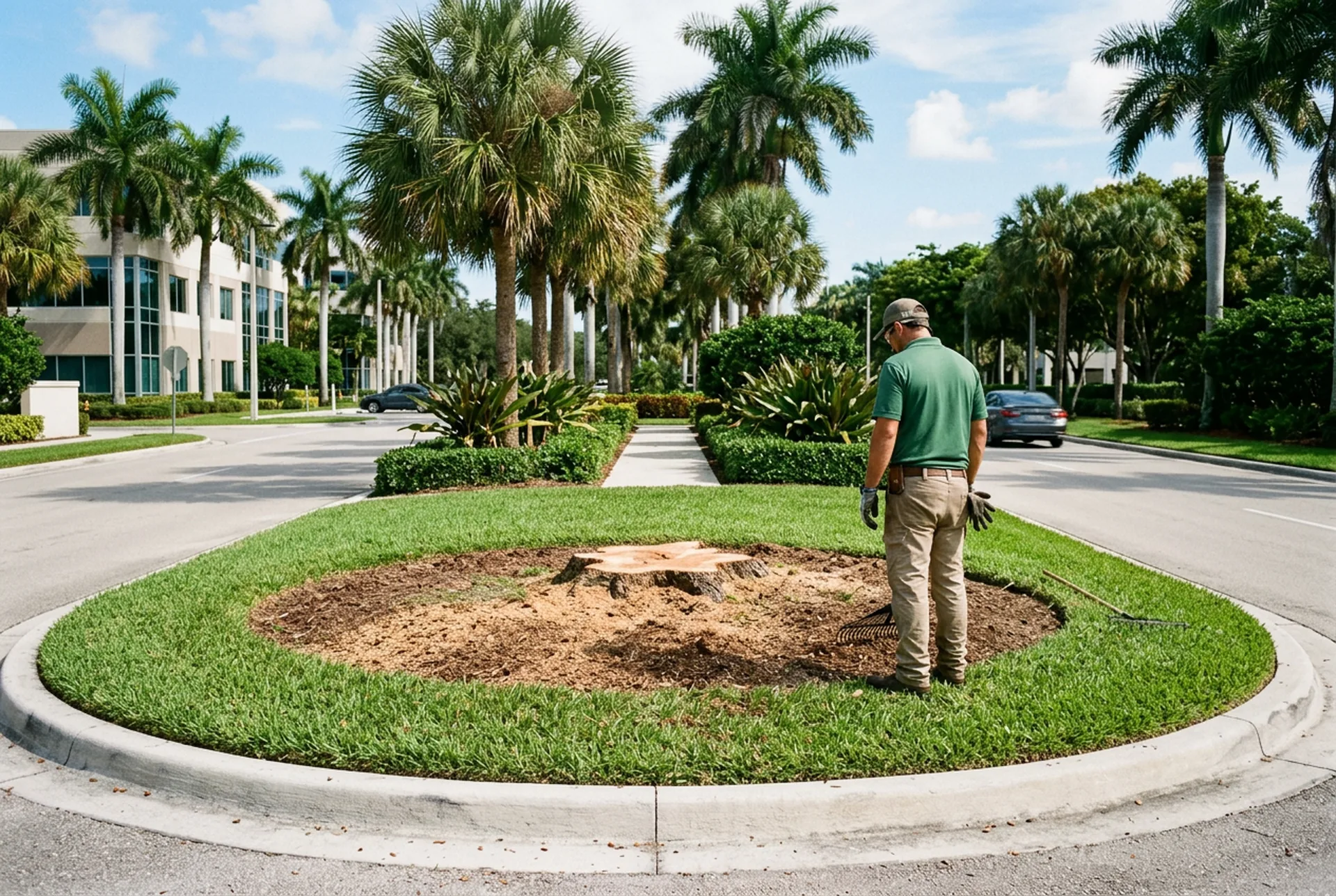
There's a stump in the entrance island. It's been there since the oak came down after last year's storm. By now it has a ring of suckers around it, a faded orange cone on top, and a permanent spot on the board's agenda. Everyone who drives in sees it. A few residents have started asking whether anyone is actually in charge of the grounds.
A leftover stump isn't a crisis. It's a small, visible sign that a job was left half finished, and on a commercial property or HOA those signs add up. For boards and property managers in Delray Beach, stump grinding is usually the last step of a tree removal and the first one to get cut from the budget. Here's how to think about it so the stump doesn't outlast everyone's memory of the tree.
Most of the time it comes down to scope. Removal and grinding often get approved as separate line items, and when a board is staring at a storm cleanup bill, grinding is the easy thing to defer. The overhead hazard is gone, and the stump feels like it can wait.
Sometimes it's access. A stump wedged between a curb, a sidewalk and a light pole is harder to reach than one sitting in open turf. And sometimes nobody is sure what's underground, so the work stalls. Those are fair reasons to pause. They aren't good reasons to leave a stump in place for a year.
More than it looks like. A low stump near a walkway is a trip hazard, and the person who trips on it is rarely the person who decided to defer the grinding. Maintenance crews have to mow and trim around it every visit, which wastes time and tends to scar the surrounding turf.
Some species also refuse to stay down. Ficus and several other common South Florida trees will push new shoots from the stump and roots, so you end up paying to cut back a tree that was supposedly removed. Stumps that don't resprout decay over time, and decaying wood attracts insects and fungi.
Then there's appearance. A stump in an entrance bed or a retail parking island reads as deferred maintenance to anyone pulling in, including the prospective buyer touring the community on a Saturday morning.
Underground utilities come first. Grinding goes below grade, and the same islands that hold trees often carry landscape lighting wires, communication lines and irrigation. Lines need to be located and marked before the work begins.
Irrigation deserves its own mention. Lateral lines and heads are frequently routed right past tree bases, and grinding near them carries a real risk of damage, so the crew needs to know where the system runs before starting.
Next, look at what's nearby. Stumps close to curbs, sidewalks, foundations or pavers need more care, because large roots often run under those surfaces. Grinding the stump doesn't remove those roots, and tearing them out can disturb whatever sits on top.
Finally, confirm whether the removal itself needed approval. Many cities in Palm Beach County regulate tree removal on commercial and association property, and some require replacement plantings. Rules vary, so check with the City of Delray Beach or Palm Beach County before the tree comes down. If your HOA or condo association has its own architectural guidelines, those apply too.
That depends on what goes there next. If the spot is going back to turf, a shallower grind with clean backfill is usually fine. If you plan to put a new tree or shrub in the same location, the grind needs to go deeper and wider so there's room for a root ball and decent soil.
Palms are a separate case. A palm doesn't leave a woody stump with spreading structural roots the way an oak or mahogany does, and it gets handled differently. Either way, decide the depth with the next step in mind.
Grinding leaves a pile of wood chips mixed with soil. It's tempting to rake that back into the hole and call it done. The trouble is that those chips break down over the following months and the area sinks, leaving a low spot that holds water and catches mower wheels. Pulling out most of the grindings and backfilling with soil gives a more stable result.
Then the spot needs a plan, because a raw patch of dirt in a maintained landscape looks almost as unfinished as the stump did.
Not automatically. First ask why the old tree came down. If it failed because it was planted too close to pavement, or because it was the wrong species for a narrow island, the same tree in the same spot sets up the same problem a few years from now. Sometimes the better call is a smaller tree, a palm, or a shrub planting that fits the space. That's a useful conversation to have as part of a broader look at landscape enhancements for the property.
Do we really need to grind the stump if the tree is already gone? On a commercial or HOA property, usually yes. Stumps create trip hazards, slow down maintenance, can resprout, and make the grounds look unfinished.
Can stump grinding damage irrigation or utilities? It can if nobody looks first. Utilities should be located and marked, and irrigation routing accounted for, before the crew starts.
Do we need a permit to remove a tree in Delray Beach? It depends on the tree and the property. Check with the City of Delray Beach or Palm Beach County before any removal.
If your property has a stump or two that have outstayed their welcome, Perfect Cut Landscaping provides tree services, including removals and stump grinding, in Delray Beach, FL, and throughout key areas of Palm Beach County. We're licensed and insured, family-run by the Snellman brothers, and serving since 2017. Call us at (561) 513-5296 or use our contact form to set up a time to walk the site.

Tell us about your property and we will arrange a site walk and a clear proposal. No pressure, no vague numbers.
Begin Your Property Review